Genesys Cloud's Latest AI Features: Turning AI-Powered Customer Service into Real ROI in 2026

AI-powered customer service has moved beyond experimentation. In 2026, the business case for artificial intelligence depends on measurable improvements in productivity, containment, resolution speed, compliance, and operating cost.
The latest Genesys Cloud updates provide a practical foundation for those improvements. New capabilities span case summarization, natural-language administration, agentic virtual agents, speech recognition, campaign personalization, APIs, conversation attributes, language support, and data sovereignty.
The technology is valuable because it connects AI to operational workflows rather than treating AI as a standalone chatbot. However, ROI depends on implementation quality, reliable data, appropriate staffing, and continuous optimization.
Important: Feature availability can vary by region, license, release schedule, and tenant configuration. The capabilities discussed below reflect information available as of September 1, 2026.
1. Start with the ROI model, not the feature list
The most effective Genesys Cloud optimization programs begin by defining the business outcome each feature should improve.
Common value drivers include:
Reduced after-contact work: Less time spent documenting calls, messages, and cases.
Higher containment: More customer requests resolved by virtual agents without human escalation.
Lower transfer and repeat-contact rates: Better context and routing across interactions.
Improved agent productivity: More interactions handled per paid hour.
Faster case resolution: Less time spent reviewing transcripts and previous contacts.
Lower administration costs: Faster creation and maintenance of workflows, schemas, and AI agents.
Reduced campaign overhead: Fewer duplicate campaigns and templates.
Lower compliance exposure: Stronger control over data residency, retention, masking, and access.
A simple ROI calculation can use the following framework:
Annual benefit = labor savings + avoided infrastructure cost + incremental revenue + avoided compliance or error cost
Net ROI = (annual benefit − annual technology and implementation cost) ÷ total cost
For example, if AI reduces average after-contact work by 90 seconds across 100,000 monthly interactions, the organization recovers approximately 2,500 labor hours per year before considering improvements in customer experience or employee capacity.
Actionable takeaway: Establish baseline metrics for average handle time, after-contact work, containment, escalation, first-contact resolution, case age, and campaign conversion before activating new AI capabilities.
2. Convert interaction history into faster case resolution
Genesys Cloud now provides AI-generated summaries for interactions linked to cases. Supervisors and case managers can view the summaries directly in Case Details without reviewing every transcript or recording.
This update addresses a common operational bottleneck: cases often contain multiple interactions across different agents and channels. A case manager may otherwise spend several minutes reconstructing the customer’s history before taking action.
A summary can help surface:
The reason for contact
Key customer concerns
Actions already taken
Resolution status
Follow-up requirements
The ROI comes from reducing case-review time and improving handoffs. For instance, a telecommunications provider handling billing disputes could use summaries to help a back-office specialist understand a customer’s previous calls before issuing a correction.
This capability complements existing Agent Copilot functions, including on-demand interaction summaries, transfer summaries, and automatic documentation support.
Organizations should measure:
Average time to first case action
Average case resolution time
Reopened-case rate
Number of interactions reviewed per case
Documentation quality and completeness
Read the official Genesys Cloud August 24, 2026 release notes for availability and licensing details.
Actionable takeaway: Begin with high-volume case categories where review time is measurable, such as billing, returns, claims, technical support, or account changes.
3. Use Copilot to reduce configuration effort
Genesys Cloud Copilot now enables administrators to create and update worktypes and schemas using natural-language instructions. AI agents can also create workitems at runtime.
This changes the economics of platform administration. Traditionally, a work automation change may require requirements gathering, object configuration, testing, documentation, and deployment. Natural-language configuration does not eliminate governance, but it can reduce the time required to produce an initial design or modify an existing one.
An administrator might describe a requirement such as:
Create a premium support worktype with intake, triage, resolution, and follow-up stages. Include customer tier, priority, SLA deadline, and product category.
The resulting configuration still requires validation. Nevertheless, Copilot can accelerate the first draft and reduce dependency on scarce platform specialists.
Potential ROI indicators include:
Time required to create or modify a worktype
Backlog of requested configuration changes
External consulting hours
Time from approved requirement to production release
Number of configuration defects discovered during testing
The Genesys Cloud Copilot overview provides broader context on natural-language administration and AI-assisted operations.
Actionable takeaway: Use Copilot for repeatable, low-risk configuration tasks first. Retain human review for permissions, compliance rules, routing logic, and customer-impacting changes.

4. Measure LAM-powered virtual agents like a production system
Large Action Model (LAM)-based agentic virtual agents are designed to perform more than scripted question-and-answer exchanges. They can use knowledge, invoke tools, call data actions, and complete defined tasks through Architect-enabled flows.
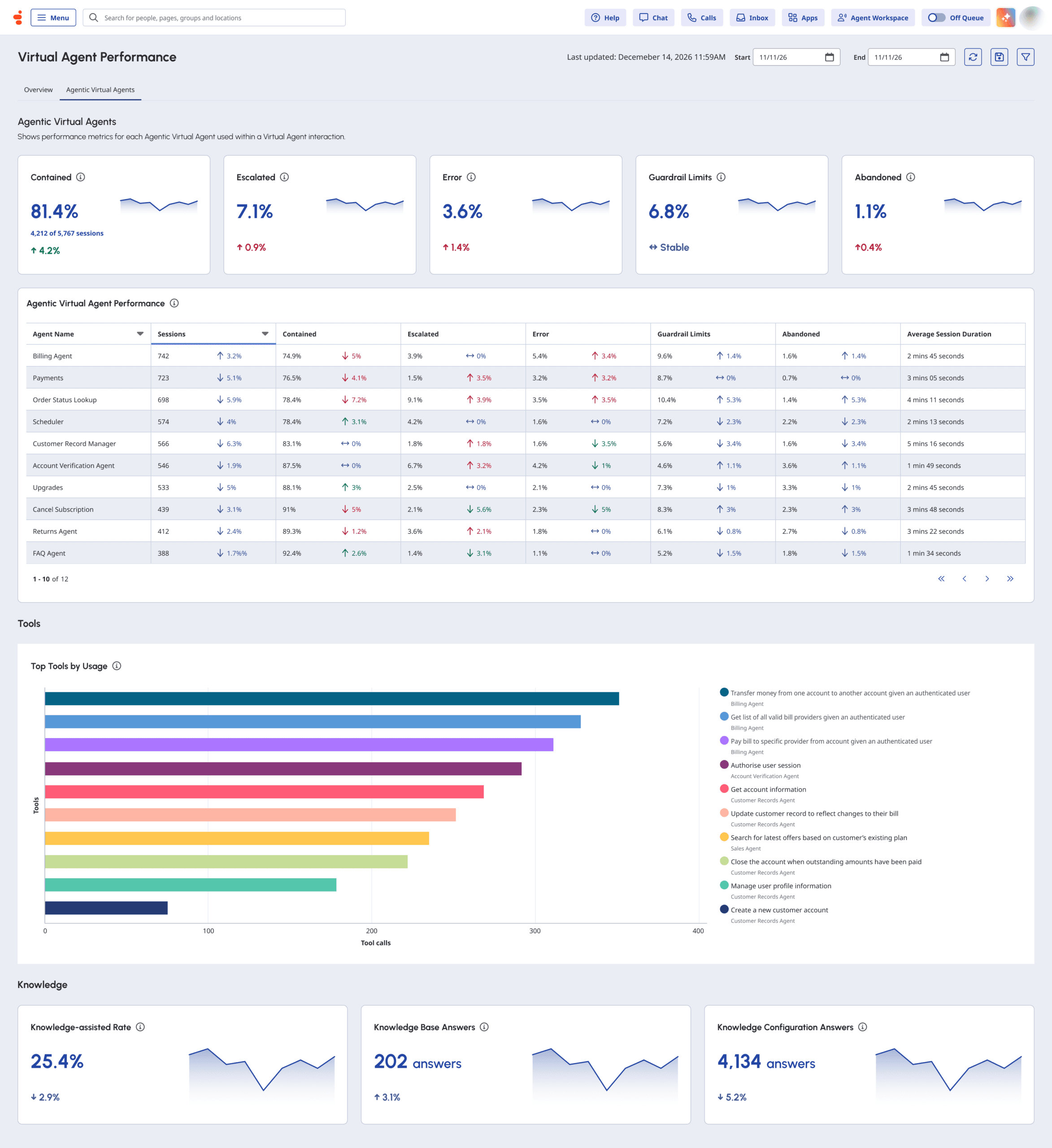
The 2026 Agentic Virtual Agent Performance dashboard provides operational visibility into:
Containment rate
Escalation rate
Error rate
Guardrail-limit outcomes
Abandonment rate
Average session duration
Tool-call volume
Knowledge-assisted sessions
This is important for ROI because a virtual agent cannot be evaluated solely by the number of conversations it handles. A high-volume virtual agent with poor containment, excessive errors, or long sessions may increase cost instead of reducing it.
For example, an order-status virtual agent should be evaluated on successful status retrieval, not just recognition of the customer’s request. A billing agent should be measured on authenticated account actions, escalation quality, and transaction completion.
A practical dashboard should compare:
Cost per contained interaction
Cost per escalated interaction
Containment by intent
Error rate by tool or integration
Average session duration
Customer effort after escalation
Genesys also provides public APIs for agentic virtual agent management. These APIs support programmatic creation, reading, updating, deleting, and publishing of agentic virtual agent configurations. This enables version control, CI/CD processes, repeatable environment migrations, and automated provisioning.
Actionable takeaway: Treat every virtual agent as a managed production service. Establish quality thresholds for containment, escalation, latency, errors, and cost before expanding its scope.
5. Improve recognition with Deepgram Flux and advanced speech settings
Genesys Cloud now supports Deepgram Flux and Nova automatic speech recognition models for virtual agents. The update focuses on end-of-speech detection and background-noise handling.
These improvements can directly affect customer experience and operational cost. Premature turn-taking can interrupt customers, trigger recognition failures, and increase transfers to human agents. Poor performance in noisy environments can produce the same result.
Organizations should test speech recognition against actual caller conditions, including:
Mobile calls
Vehicles and public spaces
Accents and regional pronunciation
Overlapping speech
Long pauses
Product names and account terminology
The goal is not simply to select the newest model. The goal is to reduce failed turns and unnecessary escalation.
Actionable takeaway: Compare recognition failure, interruption, abandonment, and escalation rates before and after model changes. Test by language, channel, and caller environment.
6. Personalize campaigns without multiplying campaign complexity
Dynamic content selection allows outbound email and messaging campaigns, including WhatsApp campaigns, to select a template at runtime based on a contact-list column.
This capability can reduce administrative overhead. A single campaign can support multiple variants based on:
Customer language
Notification type
Product or service
Customer segment
Regulatory requirement
Lifecycle stage
For instance, a service provider could use one campaign structure while dynamically selecting English, French, Dutch, or Polish content. A utility company could send different templates for payment reminders, outage updates, and appointment confirmations without maintaining separate campaigns for every variation.
ROI can be measured through:
Campaign setup time
Number of campaigns maintained
Template reuse rate
Delivery and response rates by segment
Conversion or completion rate by content variant
Actionable takeaway: Standardize campaign data fields and template governance before enabling dynamic selection. Poor source data will produce incorrect personalization at scale.
7. Use conversation attributes to carry context through the journey
New native Architect actions allow administrators and flow authors to create, retrieve, and update conversation attributes directly within flows. This reduces the need for custom Data Actions for common use cases.
Conversation attributes can carry information such as:
Booking IDs
Claim references
Case priorities
Authentication status
Customer intent
Preferred language
Previous interaction outcomes
The ROI comes from reducing duplicated data entry and improving orchestration. A virtual agent can capture a claim number, store it as a conversation attribute, and make it available to downstream routing, agent screens, reporting, or case creation.
The same context can also support more personalized transfers. A human agent may receive the customer’s intent and case priority before answering, reducing repetition and improving first-contact resolution.
Actionable takeaway: Define a controlled attribute schema. Use consistent names, data types, retention rules, and ownership across Architect flows, integrations, reporting, and CRM systems.
8. Expand multilingual service while protecting regional compliance
Genesys Cloud expanded Agentic Virtual Agent language support in 2026, including Czech, Danish, Dutch for Belgium, Filipino, Finnish, French for Belgium, Greek, Hungarian, Malay, Norwegian, Polish, Portuguese for Portugal, Swedish, and Turkish. Additional model updates also support languages such as Swiss German, Hebrew, and Thai, subject to quality validation and availability.
For multinational organizations, this can reduce the need to build separate technology stacks for every market. It can also support consistent self-service across regions and extend service hours without adding equivalent staffing capacity in each language.
However, language availability does not guarantee equal business performance. Organizations should measure:
Containment by language
Recognition failure by locale
Escalation rate
Customer satisfaction
Average session duration
Knowledge-answer success rate

For regulated European organizations, the European Sovereign Region provides an additional deployment option. Genesys Cloud made the region available as a primary site location in July 2026, with Genesys Cloud Voice services available for selected countries. The region is designed for EU data sovereignty, although optional features, third-party systems, and some international voice services may fall outside the sovereign scope.
Organizations should review the European Sovereign Region documentation and the Genesys Cloud Voice regional restrictions before designing a compliance-sensitive deployment.
Actionable takeaway: Validate language quality and data flows separately. A compliant region does not automatically make every integration or calling destination sovereign.
9. Build a measured Genesys Cloud optimization roadmap
The latest AI capabilities create the most value when deployed as an operating program rather than a collection of features.
A practical roadmap includes:
Baseline: Capture current cost, productivity, quality, and customer experience metrics.
Prioritize: Select one high-volume, high-friction use case.
Pilot: Configure the feature in a controlled flow, queue, language, or campaign.
Measure: Compare results against the baseline and a suitable control group.
Govern: Review security, data retention, licensing, integrations, and human escalation.
Scale: Expand only after the business case and operational safeguards are proven.
Genesys Cloud offers the platform capabilities, but implementation quality determines the outcome. Strong cloud communication solutions require the right architecture, flow design, integration strategy, and technical staffing model.
Dunamis Consulting Inc. helps organizations evaluate cloud telephony gaps, analyze costs, schedule Genesys Cloud projects, and provide flexible implementation and managed support staffing. With 15 years of cloud telephony experience, Dunamis can help turn new Genesys Cloud AI features into a measurable optimization plan.
Contact Dunamis Consulting to discuss a Genesys Cloud consultation, implementation roadmap, or staffing requirement.
Comments