Workforce Engagement Management on Genesys Cloud: The Cloud Telephony ROI Levers Most Businesses Overlook (2026 Guide)

Cloud telephony investments are often evaluated through infrastructure metrics: uptime, call quality, integrations, licensing costs, and deployment speed. Those measures matter, but they do not fully determine business value.
The larger ROI opportunity increasingly sits with the people using the platform.
A well-configured Genesys Cloud environment can route interactions, automate workflows, and provide powerful analytics. However, those capabilities produce stronger results when the organization has the right number of agents, with the right skills, available at the right time and supported by targeted coaching.
That is the role of Workforce Engagement Management (WEM). Genesys Cloud WEM connects forecasting, scheduling, quality management, gamification, analytics, and employee development in one operating model.
For organizations investing in cloud telephony or modernizing an existing contact center, WEM is not an optional layer. It is a practical way to convert platform capability into measurable operational performance.
1. Cloud telephony value now depends on agent performance
A cloud contact center can be technically sound and still deliver disappointing business results.
For instance, an organization may have:
Reliable voice infrastructure but long customer wait times.
Advanced routing but too few qualified agents available during demand spikes.
AI agent-assist tools but inconsistent knowledge and coaching practices.
Detailed interaction data but no process for turning insights into training.
A modern platform but high attrition caused by poor schedules and excessive occupancy.
These issues reduce the value of the underlying cloud communication solution. The platform may be working as designed, while the operating model around it is not.
Agent performance directly influences:
Average handle time.
First-contact resolution.
Customer satisfaction.
Transfer and escalation rates.
Compliance outcomes.
Schedule adherence.
Overtime and staffing costs.
Employee retention.
This is why cloud telephony optimization must move beyond infrastructure configuration. The most valuable question is no longer simply, “Is the system operating?” It is, “Is the system helping the workforce deliver better outcomes consistently?”
Actionable takeaway: Evaluate Genesys Cloud performance alongside staffing, adherence, quality, and coaching metrics. Infrastructure and workforce performance should be managed as one connected system.
2. How Genesys Cloud WEM connects the performance chain
Genesys describes WEM as a set of integrated capabilities covering workforce management, quality management, employee performance, coaching, gamification, and analytics.
The value comes from how these functions work together.
Forecasting and scheduling
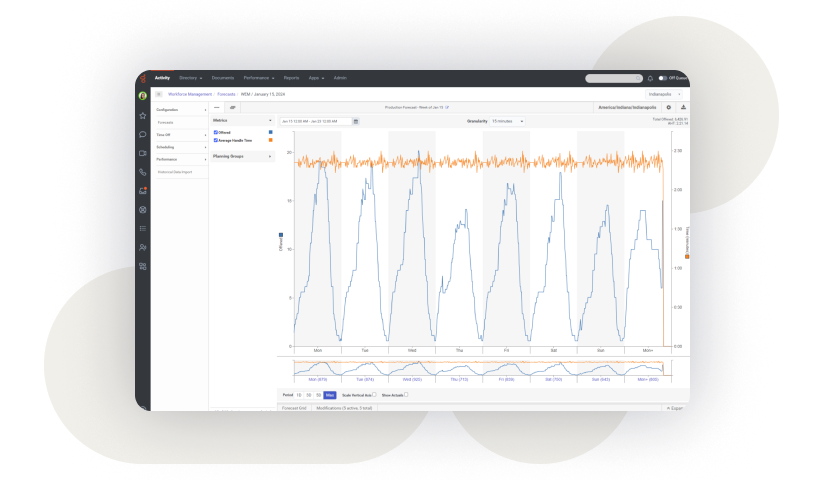
Genesys Cloud uses historical data, trends, and AI-powered forecasting to estimate future interaction volumes across voice and digital channels. Organizations can then build schedules based on expected demand, required skills, business rules, time off, and planned shrinkage.
The scheduling process can account for:
Channel demand.
Skills and proficiency levels.
Service-level objectives.
Breaks, meetings, training, and coaching.
Overtime rules.
Time-off requests.
Multiple locations and time zones.
Blended voice and digital workloads.
Genesys also supports intraday monitoring, allowing managers to compare forecasts with actual interaction volume, average handle time, service level, abandon rates, and staffing availability.
Quality management and automated QA
Traditional quality assurance often reviews a small sample of interactions. That can leave important performance patterns undiscovered.
Genesys Cloud WEM supports automated evaluation of interactions at scale. Genesys states that its conversational intelligence capabilities can analyze 100% of customer-agent conversations for signals such as sentiment, empathy, topics, summaries, and performance patterns.
That creates a broader quality dataset. Instead of coaching an agent based on five manually selected calls, a supervisor can identify recurring issues across an agent’s full interaction history.
Quality management can help identify:
Repeated compliance gaps.
Incomplete discovery questions.
Incorrect troubleshooting steps.
Excessive transfers.
Poor empathy or de-escalation patterns.
Opportunities to improve first-contact resolution.
Gamification and performance visibility
Gamification should not be reduced to leaderboards. Used responsibly, it gives agents clear visibility into performance goals and recognizes progress.
Genesys Cloud can support scorecards, leaderboards, challenges, and personalized performance dashboards. The most effective programs balance productivity with quality. A team should not be rewarded for reducing handle time if first-contact resolution and customer satisfaction decline.
Actionable takeaway: Treat WEM as a performance loop: forecast demand, schedule coverage, measure interaction quality, coach specific behaviors, and track whether performance improves.
3. Four Genesys Cloud optimization strategies with measurable impact
3.1 Use skills-based scheduling, not only headcount scheduling
A schedule with enough total agents can still fail if the required skills are missing.
Consider a technical support queue where 20 agents are scheduled. If only four are trained on a high-value product line and that product line experiences an unexpected volume increase, the team may have adequate headcount but inadequate capacity.
Skills-based scheduling aligns agent proficiency with demand by interval. Organizations should:
Map skills to queues and interaction types.
Record proficiency levels where appropriate.
Separate new, experienced, and specialized agents.
Schedule language, product, and compliance skills against forecasted demand.
Review whether skill requirements change by season or campaign.
The goal is not simply to staff every interval. It is to staff every interval with the capability customers require.
3.2 Apply intraday reforecasting
Forecasts are planning tools, not permanent commitments.
Weather events, product outages, marketing campaigns, billing cycles, and service disruptions can change demand quickly. Intraday monitoring helps workforce managers identify deviations between planned and actual performance.
A practical response may include:
Moving cross-trained agents between queues.
Delaying non-urgent offline activities.
Offering voluntary overtime.
Adjusting breaks within policy.
Reprioritizing digital work.
Escalating a service-level risk before it becomes a customer-impacting failure.
Intraday reforecasting is especially important for organizations with variable demand. It prevents managers from waiting until the end of the day to discover that the staffing plan failed at 10:30 a.m.
3.3 Automate QA across 100% of interactions
Automated QA does not eliminate human judgment. It expands the evidence available to supervisors.
Organizations should begin with a small set of measurable evaluation criteria, such as:
Correct authentication.
Required disclosures.
Resolution accuracy.
Appropriate use of knowledge articles.
Escalation quality.
Customer effort.
Empathy and communication behaviors.
The evaluation model should then be validated against human-reviewed interactions. Managers should monitor for false positives, context errors, and changes in customer or product language.
3.4 Tie AI coaching to real call drivers
Generic coaching has limited value. “Improve your communication” does not tell an agent what to change on the next interaction.
AI-supported coaching becomes more useful when linked to real call drivers. For example:
Billing confusion produces repeated “explanation” contacts.
A product defect creates a spike in escalation requests.
A policy change leads to inconsistent agent responses.
A knowledge article is difficult to find, increasing handle time.
A specific team has a high transfer rate for one interaction type.
A supervisor can use conversation analytics to identify the pattern, select representative interactions, and assign a focused coaching module. The process should combine automated insights with manager review rather than treating AI as an autonomous performance decision-maker.
Actionable takeaway: Optimize the workforce around skills, live demand, complete interaction evidence, and specific call drivers. Avoid broad coaching programs that are disconnected from operational data.
4. The AI-powered customer service link
Predictive routing and agent-assist capabilities depend on workforce readiness.
Genesys Cloud predictive routing uses AI to match customers with agents who are more likely to produce a selected outcome, such as higher customer satisfaction or first-contact resolution. Agent Copilot can provide real-time knowledge suggestions, scripts, next-best actions, translations, and automated summaries.
These capabilities are more effective when:
Agents are correctly assigned to queues and skills.
Schedules provide adequate coverage.
Historical interaction data is reliable.
Knowledge content is current.
Agents understand how to use AI recommendations.
Supervisors coach the behaviors that AI identifies.
Predictive routing cannot compensate for a shortage of qualified agents. Agent-assist tools cannot correct an outdated knowledge base. AI can recommend a next-best action, but the agent still needs the training and context to apply it appropriately.
This creates a human-machine operating model. WEM ensures that the human side of the system is staffed, prepared, and continuously improved.
For additional context on Genesys Cloud capabilities, see Dunamis Consulting’s overview of Genesys Cloud features and growth.
5. The ROI levers businesses often overlook
WEM ROI should be measured through operational changes, not software usage alone.
Shrinkage reduction
Shrinkage includes paid time when agents are unavailable for customer interactions, including breaks, training, meetings, absences, and non-adherence.
For example:
100 scheduled agents at 20% shrinkage produce 80 expected available agents.
Reducing shrinkage to 15% produces 85 expected available agents.
The improvement creates capacity equivalent to five agents without adding headcount.
That capacity can support better service levels, reduce overtime, or delay hiring.
Schedule adherence
Poor adherence creates unplanned staffing gaps. Even a small deviation during peak intervals can increase queue times and occupancy for the remaining team.
Track adherence by interval, team, activity, and time of day. Then distinguish between process problems, scheduling problems, and individual behavior.
Occupancy
Occupancy should be managed within a sustainable range. Excessive occupancy can increase stress, handle time, errors, and attrition. Very low occupancy may indicate overstaffing or inaccurate forecasts.
WEM helps organizations connect staffing assumptions to actual workload rather than relying on monthly averages.
Handle time and first-contact resolution
Reducing handle time is not automatically beneficial. If shorter calls generate repeat contacts, total workload increases.
A better analysis examines handle time alongside:
First-contact resolution.
Repeat contact rate.
Transfer rate.
Customer satisfaction.
Escalation volume.
Attrition
Balanced schedules, targeted development, and better supervisor support can improve the employee experience. Even modest reductions in attrition can create significant savings through lower recruiting, onboarding, and training costs.

6. A practical 90-day Genesys Cloud WEM adoption roadmap
Days 1–30: Establish the baseline
Document current performance for:
Forecast accuracy.
Schedule adherence.
Shrinkage.
Occupancy.
Average handle time.
First-contact resolution.
Quality scores.
Attrition and absenteeism.
Overtime and staffing costs.
Select one priority queue or business unit for the initial program. Avoid attempting to redesign every workflow simultaneously.
Days 31–60: Configure and test
During the second phase:
Validate queue and skill definitions.
Review shrinkage assumptions.
Create forecast and schedule scenarios.
Configure adherence monitoring.
Select QA evaluation criteria.
Test automated scoring against human evaluations.
Identify two or three recurring call drivers.
Build focused coaching modules.
Train supervisors on interpreting the data.
Managers should also review whether existing schedules reflect employee availability and operational constraints.
Days 61–90: Pilot, measure, and expand
Run the program with one team or queue. Compare results against the baseline and, where possible, a comparable control group.
Review:
Available capacity.
Service level.
Adherence.
Quality consistency.
First-contact resolution.
Handle time.
Agent feedback.
Coaching completion.
Overtime and repeat contacts.
Expand only after the organization understands which changes produced measurable improvement.
Actionable takeaway: Start with one measurable operational problem, prove the improvement, and then scale the WEM model across additional teams and channels.
7. Final recommendation
Genesys Cloud is more than a cloud telephony platform. Its value depends on how effectively the organization connects infrastructure, data, staffing, agent performance, and customer outcomes.
Workforce Engagement Management provides the operating discipline required to make that connection. Forecasting places capacity where demand is expected. Scheduling aligns people and skills with that demand. Automated QA reveals performance patterns. AI-supported coaching turns those patterns into targeted development. Gamification and visibility help sustain improvement.
Organizations should begin by measuring the workforce metrics that most directly influence their business case. From there, they can prioritize skills-based scheduling, intraday reforecasting, complete-interaction QA, and coaching tied to real customer needs.
Dunamis Consulting helps businesses assess gaps, plan cloud telephony projects, optimize Genesys Cloud environments, and provide flexible technical staffing and managed support. Explore Dunamis Consulting’s cloud communication solutions or review the company’s cloud telephony migration framework to identify the next practical step for your organization.

Comments